How to Understand Fuel Economy Ratings
Fuel economy ratings look simple at first: one car gets a higher number, so it should use less fuel. Then you see city MPG, highway MPG, combined MPG, trip computer averages, hybrid ratings, engine options, tire effects, and real driving conditions. Suddenly the number feels less obvious.
Learning how to understand fuel economy ratings helps you compare cars more honestly and estimate what fuel might cost in normal life. The rating is useful, but it is not a promise that every driver will see the same number every week.
I like to treat fuel economy as a planning number, not a personality test for the driver. It gives you a starting point, then your route, speed, weather, traffic, maintenance, and habits decide how close you get.
Start with what MPG is actually measuring
MPG means miles per gallon. If a car is rated at 30 MPG, the basic idea is that it can travel about 30 miles on one gallon of fuel under the test conditions behind that rating. A higher MPG number generally means the car uses less fuel to cover the same distance.
The rating is not the same as the fuel gauge. The gauge tells you how much fuel is in the tank. MPG tells you how efficiently the car uses that fuel. A large tank can make a car travel farther between fill-ups even if the MPG is not impressive, while a smaller tank can make a very efficient car stop more often.
For beginners, the useful comparison is cost over distance. A car that gets 20 MPG needs about five gallons to drive 100 miles. A car that gets 40 MPG needs about two and a half gallons for the same distance. Once fuel price is added, the difference becomes easier to understand.
That is why the same MPG rating can feel very different for two drivers. Someone who drives 300 miles a month may notice only a small fuel-cost gap. Someone who drives 1,500 miles a month will feel that difference much more often at the pump.
Separate city, highway, and combined ratings
Fuel economy ratings usually include city, highway, and combined numbers because cars use fuel differently in different conditions. City driving often includes stoplights, traffic, short trips, idling, and acceleration from low speeds. Those conditions usually lower MPG, especially in larger vehicles.
Highway driving can be more efficient because the car moves steadily, but speed still matters. Driving very fast, climbing hills, carrying heavy cargo, using roof racks, or fighting strong wind can reduce the number. Highway MPG is helpful, but it is not a guarantee for every long trip.
Combined MPG blends city and highway driving into one easier comparison. It is often the number people use when shopping, but it only makes sense if your driving is close to that mix. A driver who spends most of the week in stop-and-go traffic may care more about city MPG. Someone who commutes long distances at steady speeds may care more about highway MPG.
Do not treat one number as the whole story. If two cars have the same combined rating but one does much better in the city, the better choice may depend on your route. The rating that matches your normal driving deserves the most attention.
Use ratings to estimate fuel cost, not just bragging rights
The practical value of MPG is estimating fuel cost. Start with how many miles you drive in a typical month. Divide that by the car’s MPG estimate, then multiply by the fuel price. The result will not be perfect, but it turns a rating into a budget number.
For example, a driver who travels 1,000 miles a month in a 25 MPG car uses about 40 gallons. If fuel costs four dollars per gallon, that is about 160 dollars for the month. A 33 MPG car over the same distance uses about 30 gallons, or about 120 dollars at the same fuel price.
That difference matters more when mileage is high. If you drive only a few miles each week, fuel economy may not dominate ownership cost. If you commute daily, take long trips, or drive for work, a smaller MPG difference can become meaningful over a year.
- Estimate your monthly miles before comparing cars.
- Use combined MPG for a rough first calculation.
- Use city MPG if most trips are short or traffic-heavy.
- Use highway MPG if most driving is steady and longer distance.
- Remember that fuel price changes can shift the budget quickly.
Expect real-world MPG to move around
Real-world MPG changes because driving conditions change. Short trips are often less efficient because the car may spend more time warming up. Heavy traffic lowers efficiency because the engine works repeatedly to get the car moving. Cold weather, hot weather, air conditioning, hills, low tire pressure, and extra cargo can all affect the result.
Maintenance matters too. Underinflated tires, dragging brakes, old spark plugs on some vehicles, dirty filters in certain situations, and neglected service can reduce fuel economy. The rating assumes a properly maintained vehicle, not a car carrying a roof box on low tires through heavy traffic.
A single bad tank does not always mean something is wrong. Look for patterns. If MPG drops suddenly and stays low, then it is worth checking tire pressure, recent driving conditions, warning lights, fuel quality, and whether anything changed on the car.
Seasonal changes can also explain shifts. Winter fuel blends, cold starts, defroster use, and lower tire pressure can all reduce mileage. Summer heat, heavy air-conditioning use, and long idling can do the same. Those changes are frustrating, but they are not always mechanical failures.
Fuel economy is most useful when you compare patterns, not one perfect number.
Read dashboard averages with caution
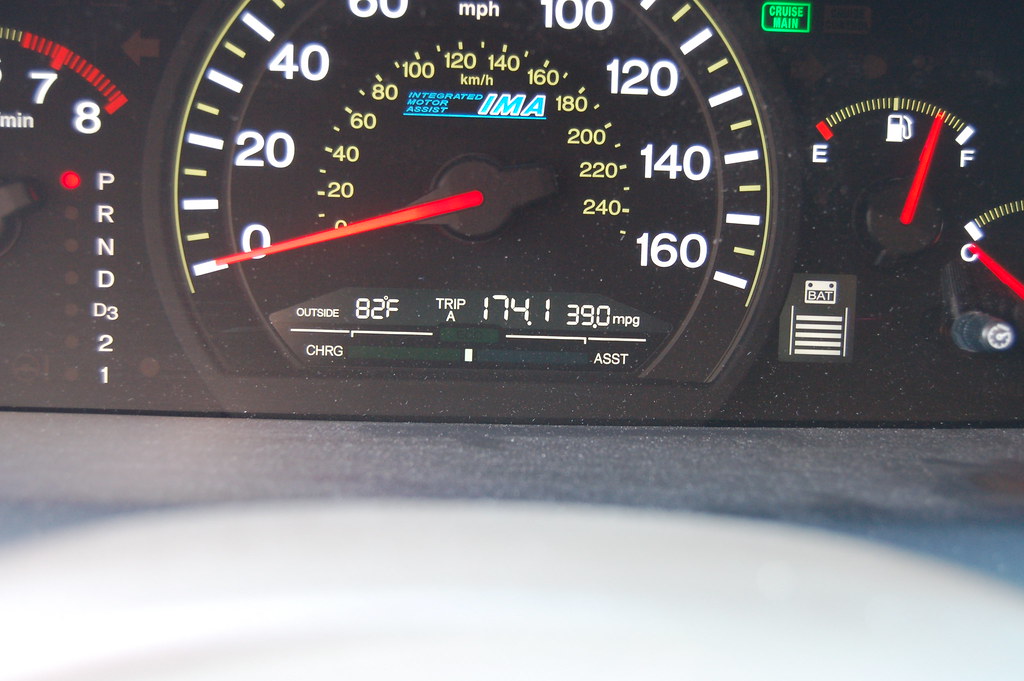
Many cars show average MPG on the dashboard or trip computer. That display can be helpful, but it depends on how it is reset and what driving happened during the measurement. A short downhill drive may show a great number. A week of cold starts and traffic may show a disappointing one. Neither number tells the whole story by itself.
If you want a cleaner comparison, reset the trip average after filling up and track a full tank. You can also calculate manually by dividing miles driven by gallons added at the next fill-up. The manual method is not perfect either, because pumps and fill levels vary, but it can reveal whether the dashboard estimate is close.
Dashboard averages are especially easy to misread after a reset. The first few miles can swing wildly because there is not much data yet. Wait until you have driven a meaningful distance before deciding the number represents the car’s normal behavior.
Use this simple routine when comparing fuel economy:
- Fill the tank and reset the trip meter.
- Drive normally for most of the tank.
- Fill up again at the same general pump angle if possible.
- Divide miles driven by gallons added.
- Compare that number with the dashboard average.
- Repeat over several tanks before judging the trend.
Compare cars by your driving, not only the sticker
Fuel economy ratings are most useful when matched to your real life. A compact hybrid may look excellent in city driving. A larger vehicle may make sense if you regularly carry family, cargo, tools, or travel in conditions where size and capability matter. The best number on paper is not always the best ownership choice.
Compare the vehicles you are actually considering, then estimate fuel cost using your monthly miles. Also think about fuel type, insurance, maintenance, tires, purchase price, and how long you plan to keep the car. A small MPG advantage can be outweighed by a much higher purchase price, but for high-mileage drivers it can also save real money.
Before choosing, ask practical questions:
- Do I mostly drive in traffic, on highways, or a mix of both?
- How many miles do I drive in a normal month?
- Will this car carry extra passengers or cargo often?
- Does it require regular fuel or a more expensive grade?
- Would a lower fuel bill matter more than extra power or size?
Fuel economy ratings do not need to be confusing. Read city, highway, and combined MPG separately, estimate fuel cost from your own mileage, and expect the real number to move with conditions. That gives you a calmer way to compare cars and understand what the dashboard is telling you after you buy one.